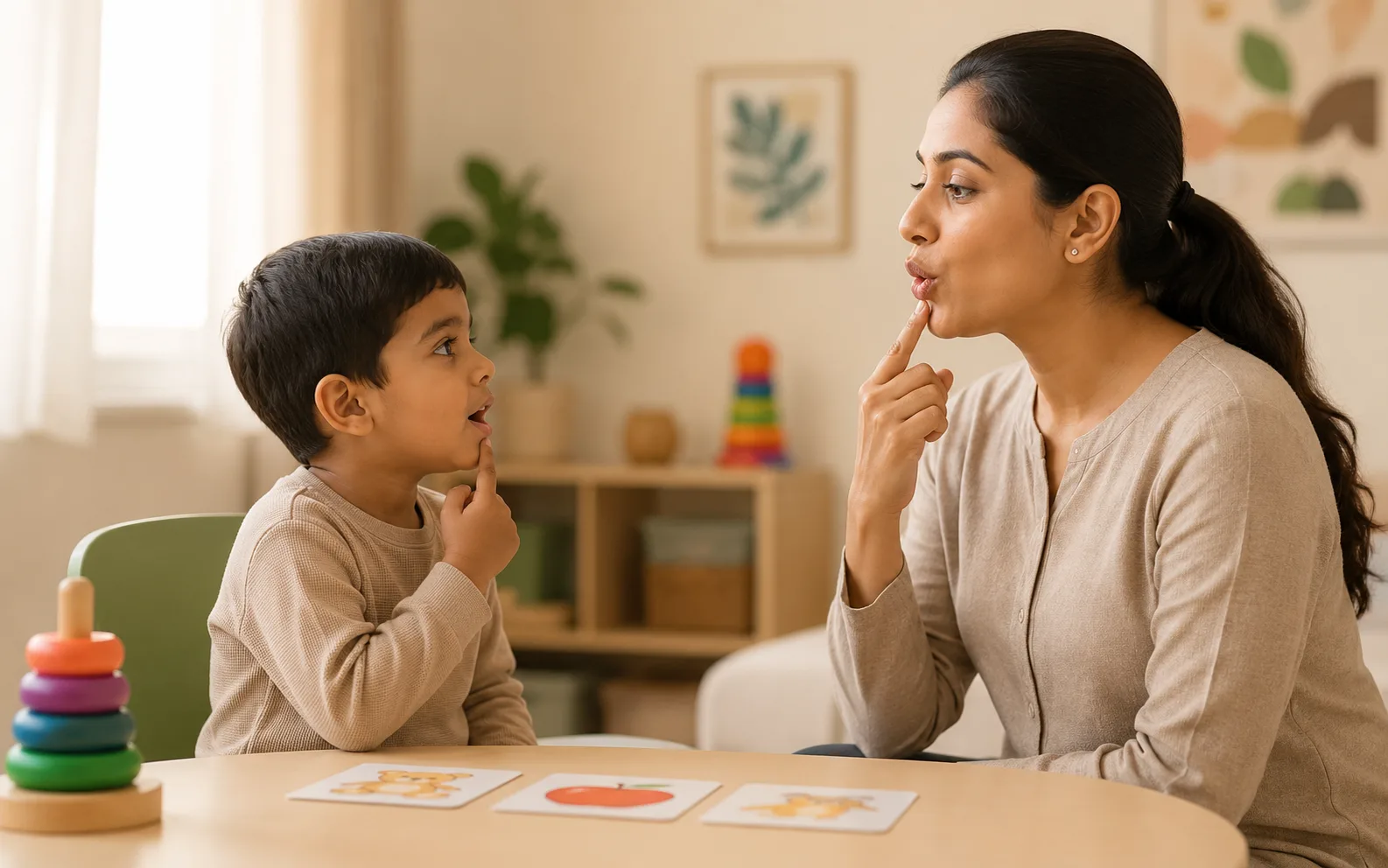
What is selective mutism?
Selective mutism is an anxiety disorder in which a child who is capable of speaking fails to speak in specific social situations — typically school, public settings, or around unfamiliar people — despite speaking normally at home or in comfortable environments. It is not a choice, a developmental delay, autism, or defiance. The child is not choosing not to speak — they are experiencing a freeze response triggered by anxiety. In India, selective mutism is widely misunderstood and frequently attributed to shyness, stubbornness, or family environment. It is a recognised clinical diagnosis and responds well to specific evidence-based therapy when identified early.
How selective mutism presents in Indian settings
In Indian classrooms, selective mutism is often described as 'very shy', 'won't speak up in class', 'scared of the teacher', or 'speaks only in mother tongue'. Children with selective mutism may: answer only in whispers or through nods and headshakes, communicate through a sibling or close friend who relays their words, be completely silent at school but chatty at home, show physical signs of anxiety (flushing, freezing, avoidance) when expected to speak. The critical distinguishing feature is the clear contrast between home speech and school/social speech — this is the hallmark of selective mutism, not of general shyness.
When does selective mutism typically start — and who does it affect?
Selective mutism most commonly begins when children first encounter structured social settings — typically around age 3–5, coinciding with preschool or kindergarten entry. Girls are slightly more affected than boys. Children with a family history of anxiety disorders, social anxiety, or selective mutism itself are at higher risk. Children from bilingual or multilingual families who are still acquiring a new language (like English in Indian schools) may show silence at school that is not selective mutism but is language adjustment — distinguishing between the two requires a careful clinical assessment.
What evidence-based treatment looks like
The most effective treatment for selective mutism combines: behavioural approaches (systematic desensitisation, stimulus fading, shaping) to gradually introduce speaking in anxiety-provoking settings, CBT (Cognitive Behavioural Therapy) for older children and adolescents, parent and school collaboration — both environments must be part of the treatment plan, and sometimes medication (SSRIs) for moderate to severe cases in collaboration with a paediatrician or child psychiatrist. The treatment goal is not 'forcing' the child to speak but systematically reducing the anxiety response through graded exposure. An experienced SLP or psychologist with selective mutism expertise should lead the programme.
How online therapy works for selective mutism
Online therapy has a particularly useful property for selective mutism treatment: the home environment — where the child speaks freely — becomes the setting for sessions. This means the therapist can observe the child's natural speech, gradually build rapport in a non-threatening format, and implement graded exposure steps that move from home (low anxiety) toward school settings (higher anxiety) progressively. Parent training is central: parents need specific strategies to avoid inadvertent reinforcement of mutism (answering for the child, accepting silence) while also not increasing pressure. School liaison — where the therapist communicates a management plan to teachers — is part of the care package.
Ready to take the next step?
Book a triage call about Speech delay
Understand what the concern is and what good care looks like — before you commit to anything.
WhatsApp us — triageCommon questions
My child speaks perfectly at home but won't say a word at school. Is this selective mutism?
This presentation is consistent with selective mutism, particularly if it has been present for more than a month and isn't explained by a new language environment. A formal assessment by an SLP or psychologist with selective mutism experience is the right next step.
Will my child grow out of selective mutism?
Some children with mild selective mutism do improve over time, particularly with a supportive school environment. However, untreated selective mutism often persists and can significantly affect academic performance and social development. Early structured intervention produces the best outcomes.
Is selective mutism the same as autism?
No. Selective mutism is an anxiety disorder, not an autism spectrum condition. Some autistic children also have selective mutism, but they are different conditions. An assessment can distinguish between them — which matters because the treatment approaches are different.
Should I be putting pressure on my child to speak?
No. Pressure and demand — even well-intentioned — typically worsen selective mutism by increasing anxiety. The treatment approach is the opposite: removing demand, building rapport and comfort, and using very gradual graded exposure. Your therapist will give you specific strategies to support your child without inadvertently reinforcing the silence.
Available across India
And online to every PIN code in India.
This article is for general information and does not replace an individual clinical assessment. Read our full medical disclaimer →